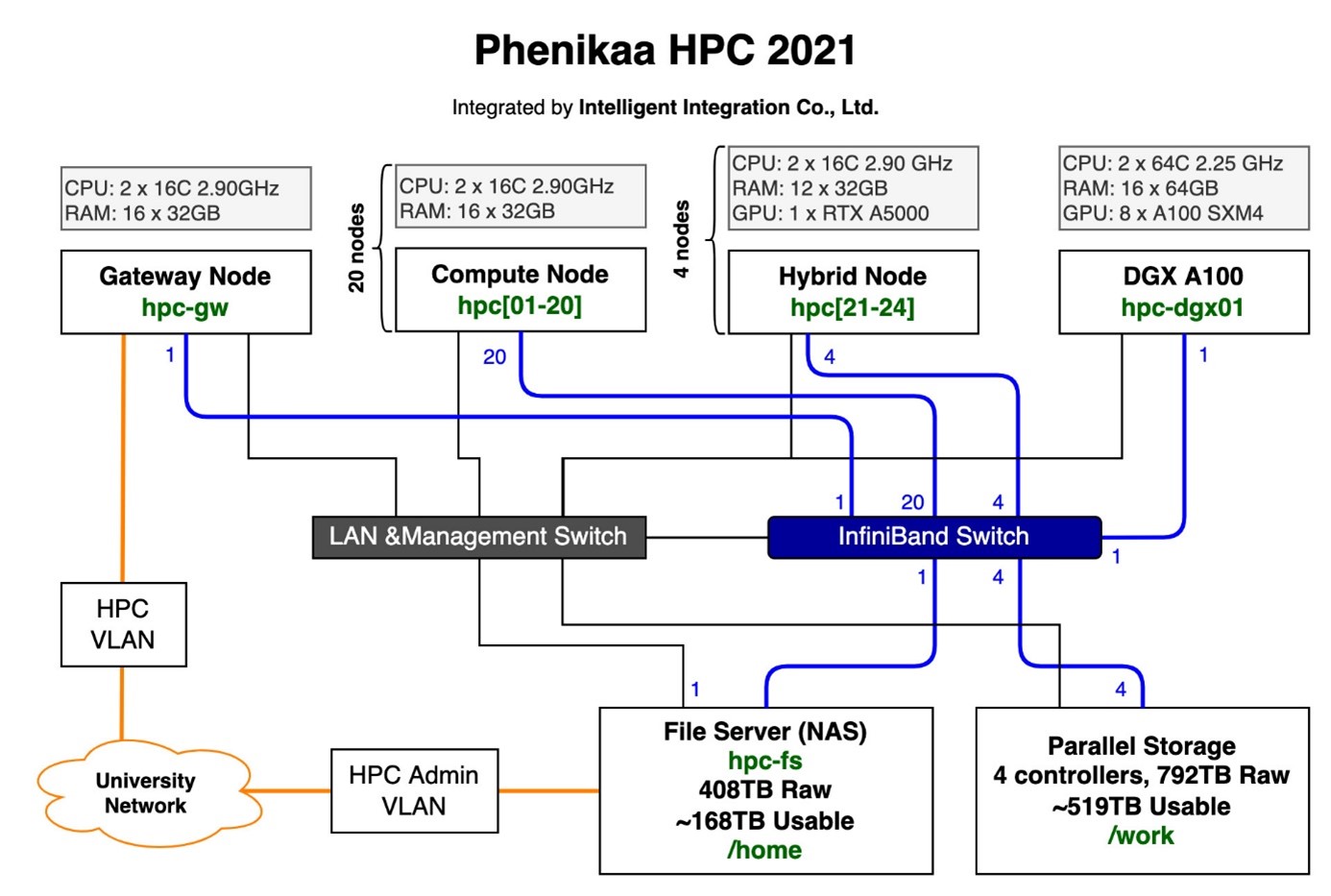
Architecture
A typical Slurm (Simple Linux Utility for Resource Management) cluster consists of three main components:
- slurmctld (Slurm Controller Daemon)
- slurmd (Slurm Daemon for Compute Nodes)
- slurmdbd (Slurm Database Daemon, optional but recommended for accounting)
Each component runs on different types of nodes in the cluster.
Node Types and Services
| Node Type | Services Installed | Description |
|---|---|---|
| Controller Node | slurmctld | The central management node that schedules jobs and tracks resources. |
| Compute Nodes | slurmd | Worker nodes that execute jobs submitted to the cluster. |
| Login Nodes | Slurm client tools | Users log in here to submit jobs and manage workloads. |
| Database Node | slurmdbd, MySQL/MariaDB | Stores job accounting and usage information if needed. |
Detailed Breakdown of Components
1. slurmctld (Slurm Controller Daemon)
- Runs on the controller node (or multiple nodes in High Availability (HA) setup).
- Responsible for scheduling, managing jobs, and tracking resources.
- Receives job submissions from users and allocates compute resources.
- Communicates with slurmd on worker nodes to execute jobs.
2. slurmd (Slurm Node Daemon)
- Runs on compute nodes (worker nodes).
- Receives job execution commands from slurmctld.
- Reports back job progress and node status to the controller.
3. slurmdbd (Slurm Database Daemon)
- Runs on a database node or the controller node (if a small cluster).
- Connects to an SQL database (MariaDB/MySQL).
- Stores job accounting data, such as completed jobs, user resource usage, and fair-share scheduling.
Cluster Example
For a medium-sized cluster, you might set up:
- 1 Controller Node: Runs slurmctld and optionally slurmdbd.
- 1 Database Node (optional): Runs slurmdbd and a database.
- 2 Login Nodes: Allow users to connect and submit jobs.
- Multiple Compute Nodes: Run slurmd to execute jobs.
For small clusters, you can combine the controller and database node into a single machine. For slurm small cluster, it can be configured as below: